Korean Film ‘Parasite’ Wins the Palme d’Or at Cannes
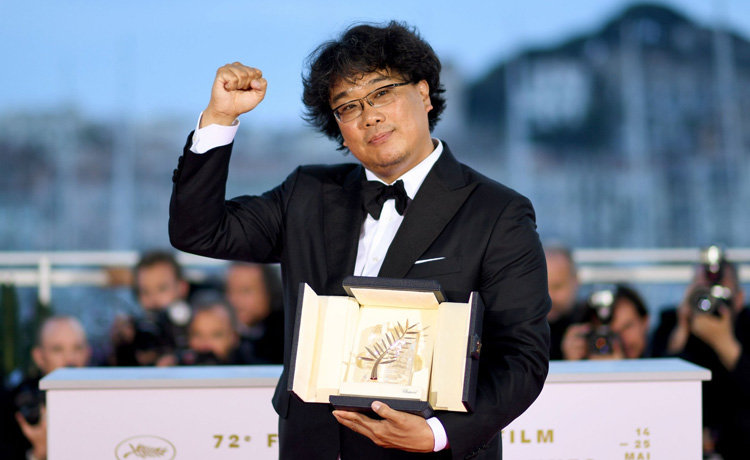
variety.com: The 72nd edition of the Cannes Film Festival wrapped with jury president Alejandro González Iñárritu announcing the group’s unanimous decision to award the Palme d’Or to South Korean director Bong Joon-ho for his sly, politically charged “Parasite.” Following last year’s win for humanistic Japanese drama “Shoplifters,” the well-reviewed Asian thriller represents the yin to that film’s yang: the story of a lower-class family who try to improve their social situation by infiltrating a rich household.
Explaining the group’s collective enthusiasm for “Parasite” at the post-ceremony press conference, Iñárritu said, “We all shared the mystery of the unexpected way this film took us through different genres and spoke in a funny, humorous, tender way — with no judgment — of something so relevant and urgent, so global in such a local film, with such a beautiful efficiency of media, and an understanding of what film really is. We were all fascinated when we saw it, and it kept growing and growing: that’s why it was a unanimous decision.”
French-Senegalese filmmaker Mati Diop earned the Grand Prix for her debut feature, “Atlantics.” Diop, who made history as the first black female filmmaker in competition, dramatizes a seldom-seen side of Europe’s refugee crisis through the eyes of a woman abandoned by the man she loves, when he decides to attempt an illegal crossing.
Calling Diop’s film “a beautiful fable,” juror Elle Fanning said, “Though it deals with these issues, it also felt personal and vulnerable, very emotional and just quite precious.” The 21-year-old actress — “a millennial surrounded by old people,” quipped Iñárritu — described her Cannes experience as one that has made her “view cinema differently, and for the good.”
Best actress went to British rising star Emily Beecham for Jessica Hausner’s “Little Joe.” In the critically divisive sci-fi film, she plays a scientist who begins to suspect that the plant she has genetically modified may have adverse side effects.
Accepting the trophy for best actor, Antonio Banderas reflected on his 40-year path to such recognition, awarded for his leading turn in Pedro Almodóvar’s semi-autobiographical “Pain and Glory.” Dedicating the award to Almodóvar, Banderas said, “People think we live in a red carpet, but it’s not true. We suffer a lot, we sacrifice, and there is a lot of pain behind an actor of any kind. But there is also glory, and this is my night of glory,” before promising, “The best is still to come.”
Presenting a tie for the jury prize — awarded to a pair of politically charged features, Ladj Ly’s “Les Misérables” and Kleber Mendonça Filho and Juliano Dornelles’ “Bacurau” — outspoken liberal filmmaker Michael Moore told the crowd, “Trump is the lie that enables more lying.”
Cannes favorites Jean-Pierre and Luc Dardenne — who have won the Palme d’Or twice before, as well as two other awards — took the best director prize for “Young Ahmed,” the portrait of a Muslim teenager living in modern Belgium who attempts to kill his teacher after being brainwashed by a radical imam.
French writer-director Céline Sciamma earned the screenplay award for “Portrait of a Lady on Fire,” a lesbian-themed period film that explores the notion of the female gaze, both now and throughout the tradition of Western art.
Elia Suleiman’s “It Must Be Heaven” earned a special mention from the jury. A droll commentary — from a director whose Jacques Tati-like screen persona hardly ever speaks — on his country’s troubles, as reflected through his travels to Paris and New York, Suleiman’s film was the rare comedy in this year’s competition.
Noting that most of their chosen films dealt with relevant sociopolitical themes, Iñárritu noted, “Art can sometimes see the future… I think that now cinema has an urgency of social consciousness ex