Oscar-Winning Director of ‘One Flew Over the Cuckoo’s Nest,’ Milos Forman Dies at 86
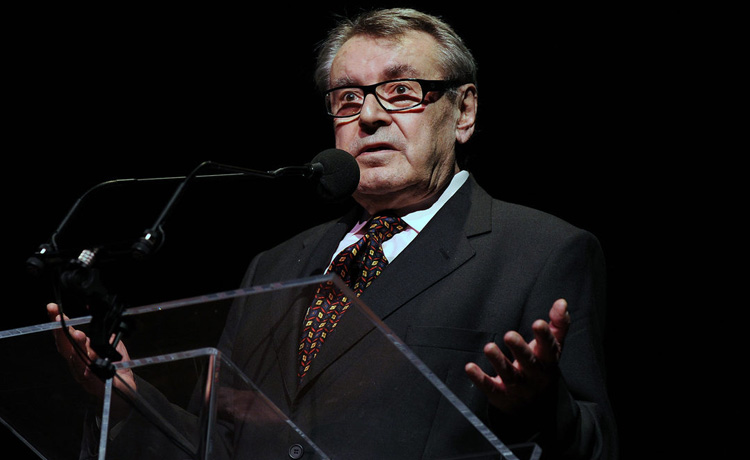
Variety.com: Czech-born director Milos Forman, who won best directing Oscars for “One Flew Over the Cuckoo’s Nest” and “Amadeus,” has died. He was 86.
Forman died Friday in the U.S. after a brief illness, his wife, Martina, told the Czech news agency CTK. She said that “his departure was calm, and he was surrounded the whole time by his family and his closest friends.”
Forman was also known for directing “Hair,” “Ragtime” and “The People vs. Larry Flynt.”
Directors’ Guild president Thomas Schlamme said, “Miloš was truly one of ours. A filmmaker, artist, and champion of artists’ rights. His contribution to the craft of directing has been an undeniable source of inspiration for generations of filmmakers. His directorial vision deftly brought together provocative subject matter, stellar performances and haunting images to tell the stories of the universal struggle for free expression and self-determination that informed so much of his work and his life.
“A member of the DGA’s National Board and a recipient of the DGA’s highest honor, the Lifetime Achievement Award, Miloš actively championed artist’s rights throughout his career, speaking multiple times before Congress and world audiences about the importance of creative rights and artists’ protections against the violation of those rights. He stood up on behalf of his beloved fellow filmmakers time and again, and he believed with all his heart that creativity and artistic freedom could make a difference in the world. Now it’s up to us to prove him right. We will miss him.”
Having made just one American film at the time, the ironic comedy “Taking Off” (1971), which won critical acclaim but failed to connect with audiences, Forman seemed an unlikely choice to direct the adaptation of Ken Kesey’s countercultural novel “Cuckoo’s Nest.” But he brought a balance and objectivity to the film, which could easily have descended into histrionics. The critically lauded and immensely popular film starring the fast-rising Jack Nicholson struck a nerve in 1975, and on Academy Awards night it became the first film since 1934’s “It Happened One Night” to sweep the top five Oscar prizes: best picture, director, actress, actor and screenplay (adapted).
To shoot “Amadeus,” Forman returned to his native Czechoslovakia in 1983 and used little-known theater actors to play Wolfgang Amadeus Mozart (Thomas Hulce) and his rival Antonio Salieri (F. Murray Abraham), Forman created a compelling and cogent adaptation of Peter Shaffer’s award-winning stage play — helped in great measure by the magnificent Mozartian score. Again, Forman ruled the Oscars, taking another director trophy as the film also drew awards for picture, actor (Abraham), and screenplay, winning eight awards in all. The film was also his most financially successful after “Cuckoo’s Nest.”
With a style that film historian David Thomson said stressed the everyday over the melodramatic and a flair for improvisation, Forman had flourished as a young director in Czechoslovakia with such satirical films as 1966’s “Loves of a Blonde” and 1968’s “The Firemen’s Ball,” the latter of which was refused a showing in his native country because of its satire of bureaucratic thinking.
Forman was in Paris in August 1968 when Russian tanks rolled into Czechoslovakia, ending the Warsaw Pact country’s brief artistic renaissance. Soon thereafter he moved to New York, joining another celebrated Czech director, Ivan Passer, who had penned “Loves of a Blonde” with Forman and others. Forman’s first U.S. film, “Taking Off,” was similar in approach and style to his earlier work, and while it was praised by critics, it did little to establish him as an American director. He also took on “The Decathlon” episode of “Visions of Eight,” a compilation documentary of the Olympics by an octet of different helmers.
Over the years Forman directed few films, and his Ameri