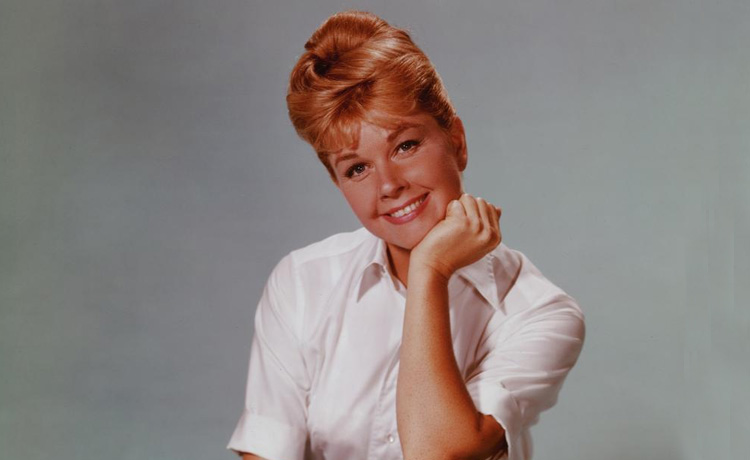
Doris Day, Hollywood's Box Office Star in the 1950s and 1960's Died at 97
Variety.com: Doris Day, one of Hollywood’s most popular stars of the 1950s and ’60s who was Oscar-nommed for “Pillow Talk” and starred in her own TV show, has died. She was 97.
The Doris Day Animal Foundation confirmed the legendary actress-singer died on Monday at her Carmel Valley, Calif. home.
Though she was marketed as a wholesome girl-next-door type, the comedies for which she was most well-known were actually sexy and daring for their time, and her personal life was tumultuous, with four marriages and a notorious lawsuit.
The vivacious blonde, who also had a successful singing career, teamed with Rock Hudson in “Pillow Talk” and other lighthearted romantic comedies including “Lover Come Back” and “Send Me No Flowers.” Her other significant screen roles included Alfred Hitchcock thriller “The Man Who Knew Too Much” (1956), co-starring James Stewart and featuring Day’s Oscar-winning song “Que Sera Sera (Whatever Will Be, Will Be”); and “The Pajama Game” (1957), based on the Broadway musical.
After many successful films, she starred on CBS in “The Doris Day Show” for five years starting in 1968, and soon after retired to Carmel, Calif. She released 29 albums, most recently “My Heart,” which consisted of previously unreleased songs, in 2011.
In her autobiography, “Doris Day: Her Own Story,” she caused something of a stir while promoting the book by rejecting the “girl next door” and “professional virgin” labels so often attached to her. In the 1975 book she remarked: “The succession of cheerful, period musicals I made, plus Oscar Levant’s highly publicized comment about my virginity (‘I knew Doris Day before she became a virgin’), contributed to what has been called my ‘image,’ which is a word that baffles me. There never was any intent on my part either in my acting or in my private life to create any such thing as an image.”
But her rise in popularity coincided with World War II and the Korean War, and she quickly became a favorite with servicemen. Day leapt into the spotlight in 1945 with the release of her hit song “Sentimental Journey,” recorded with Les Brown and His Band of Renown; the song became symbolic for G.I.s returning from WWII to their families. She had also done early vocal work with the big bands of Barney Rapp and Bob Crosby. She had a second hit record with “My Dreams Are Getting Better All the Time.”
After she separated from her second husband, George Weidler, in 1948, Day apparently intended to leave Los Angeles and return to her mother’s home in Cincinnati. Her agent, Al Levy, convinced her to attend a party at the home of composer Jule Styne. There she performed the song “Embraceable You,” impressing Styne and partner Sammy Cahn; they recommended her for a role in “Romance on the High Seas,” on which they were then working for Warner Bros. The main role was to be recast after Betty Hutton exited due to pregnancy, and Day got it.
The Michael Curtiz-directed musical comedy, her debut feature film gig, provided her with another hit recording, the Oscar-nominated “It’s Magic.” Day starred in a number of Curtiz films in the early and mid-’50s, among them “Young Man With a Horn” with Kirk Douglas and Lauren Bacall.
In the early ’50s she made a series of nostalgic period musicals for Warner Bros., including “Tea for Two,” “On Moonlight Bay” and “By the Light of the Silvery Moon,” for Warner Brothers. Attempting to cut loose from her dainty image, Day began accepting more nuanced parts, including her favorite role as Western tomboy Calamity Jane in director David Butler’s 1953 film of the same name.
The New York Times called Day’s performance in the Hitchcock’s “The Man Who Knew Too Much,” in which she was well cast as a retired singer, “surprisingly effective.”
Day was apparently not an immediate fan of “Que Sera Sera” and expressed doubts about the durability of the tune that would beco